Technology Valley x Edara: A Growth Journey Powered by a System That Scales
4 Reading minutes
“Technology Valley“’s growth over the past decade wasn’t just about opening new branches—it was a continuous test of whether their system could keep pace with a business that was expanding in every direction. With every new branch, every jump in sales volume, and every addition to their product range, the demand for clearer data and unified control became even more critical.
For more than ten years, the company kept scaling, and the system remained a steady part of the operation—delivering real-time information, keeping workflows consistent, and absorbing each stage of growth without slowing it down.
Their journey wasn’t only about expansion. It was about choosing a platform that remained reliable as the business grew—one that kept up with the pace instead of holding it back.
Growth Challenges: When the Details Multiply and Visibility Becomes Critical
“Technology Valley”’s expansion didn’t simply mean more branches—it meant a sharp increase in the volume of details that had to be monitored every single day. With every new branch, the data multiplied, and the product range widened to include computers, laptops, hardware components, and electronic accessories. Each item carried a serial number that needed to be tracked accurately across multiple warehouses.
At the same time, frequent import shipments added new SKUs on a regular basis, making warehouse operations far more complex. This created an urgent need for a clear financial picture covering costs, expenses, shrinkage, income statements, budgets, and proper cost allocation across cost centers.
With an active online store in the mix, the challenge grew even further. In a fast-moving electronics market, any mismatch between system stock and website stock—or any delay in updating branch data—directly impacted the customer’s experience. A price difference or an unavailable item could instantly translate into a lost sale.
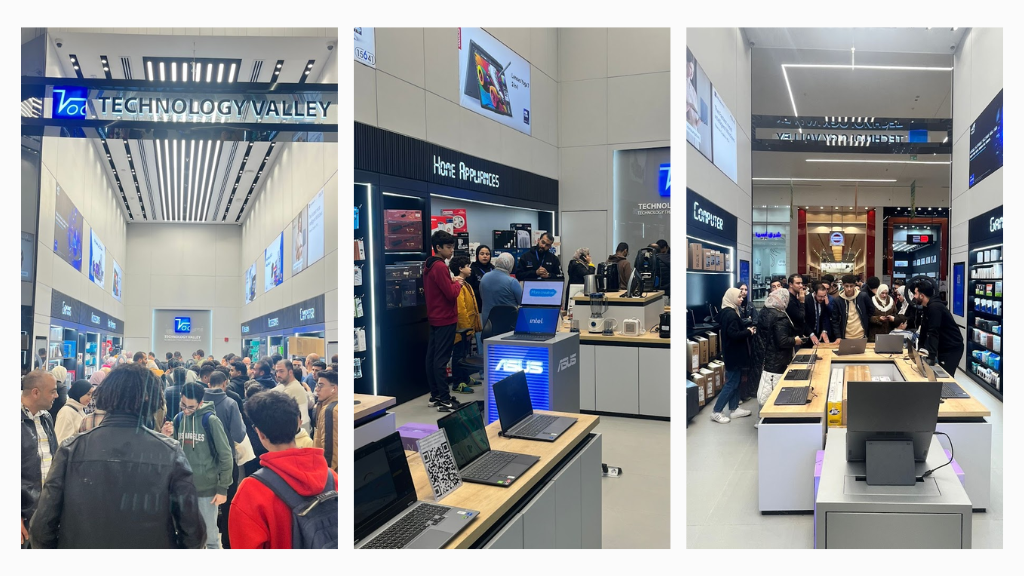
Amid all this growth, one critical question stood before management: Can the system remain reliable as the workload doubles, or will it become part of the problem?
A Stable Operating Backbone: How the System Supported a Business That Evolved Every Year
For more than a decade, “Technology Valley”’s continuity wasn’t driven by commercial expansion alone—it was built on an operational backbone that stayed clear and consistent, even as the scale of the business changed. Centralizing all branches under one system kept data unified and ensured accurate tracking of sales and inventory, no matter where transactions took place.
On the financial side, accounts, budgets, and income statements continued to run with steady rhythm, giving management the visibility they needed to measure performance and make confident decisions.
Warehouse operations—receiving, issuing, transfers, stock counts, and imports—formed a complex cycle that required a system capable of handling daily detail without overwhelming the team. And in a market where warranties and after-sales service depend heavily on product traceability, serial-number tracking was non-negotiable. The system delivered this with precision, managing thousands of serials across multiple branches and warehouses seamlessly.
What the company needed was a system that could absorb growth without restricting it—a platform that remained clear, reliable, and scalable as data increased year after year.
That is exactly what “Edara” provided.
Multi-Channel Integration: Branches, Online Store, and ETA in One Flow
As “Technology Valley” expanded across multiple sales channels, unified data became essential for keeping operations efficient. The business no longer ran through branches alone; a busy online store was receiving orders every day and required real-time stock levels and pricing—without any mismatch between the system and the website.
Through direct integration between the e-commerce platform and “Edara”, stock movements flowed automatically between both sides. Every online sale was recorded instantly, and every inventory update appeared on the website in real time, ensuring a consistent buying experience whether the customer shopped in-store or online.
The integration with the ETA also streamlined compliance with government requirements, making invoice issuance and synchronization a natural part of the daily workflow—without any extra steps or disruptions.
Operational and Financial Tools That Reinforced Accuracy and Stability
“Technology Valley” relied on a set of built-in tools that strengthened both operational precision and financial control.
The Dormant Accounts report helped the management team identify customers with no recent activity and improve their collection cycle. The company also leveraged customizable barcode printing, which made it easier to organize a wide variety of products across branches.
In warehouse management, the team used controlled warehouse visibility within the stock balance report—allowing branches to view their own available stock while hiding the quantities stored in the main warehouse. This was especially useful during import periods when large shipments had arrived but had not yet been distributed, keeping incoming quantities confidential while maintaining operational clarity for each branch.
They also utilized the Fixed Assets–Cost Center linkage, which enabled precise tracking of each asset’s location and automated posting of depreciation based on the responsible branch. In addition, Collection Fee settings improved financial accuracy by clearly defining the fee percentage, who bears it, and reflecting the final payable amount directly on printed documents.
Together, these operational and financial tools elevated discipline across the organization, delivering accurate, reliable data that supported informed and confident decision-making.
What Does It Mean for a System to Scale as the Business Expands?
This stability wasn’t the result of a rigid system—it came from an operating foundation that evolved in parallel with the company’s growth and adapted as new realities emerged. The system wasn’t just a tool for running day-to-day operations; it became part of the company’s core structure, expanding steadily to absorb more data and more complexity year after year.
Real growth doesn’t happen by switching to a new system every time the business expands. It happens when the system itself grows with the company—neither ahead of it nor behind it.
And that is what shaped “Technology Valley”’s journey: a path of consistent expansion, where daily operations ran confidently, and decisions were built on visibility that stayed clear no matter how large the business became.
Related articles
How did Edara maintain operational stability for Gabriel, an authorized Elsewedy distributor?
In Downtown Cairo’s electrical market, work rarely follows a steady rhythm. The pace is constant, customers move in and out all day, retail sales overlap with wholesale orders and supply…

“El Hegaz” and “Edara”: One System Connecting Branches, Suppliers, and Customers in a Seamless Workflow
In a fast-growing market like computer hardware and accessories, success isn’t just about selling more — it’s about managing growth efficiently. Every new branch, supplier, and transaction adds another layer…

From Family Roots to Future Success: Elbadr Group’s Journey with “Edara”
In the heart of Shubra, Greater Cairo, where busy streets and the clatter of auto parts create a lively backdrop, a legacy of automotive excellence has taken root. Founded in…